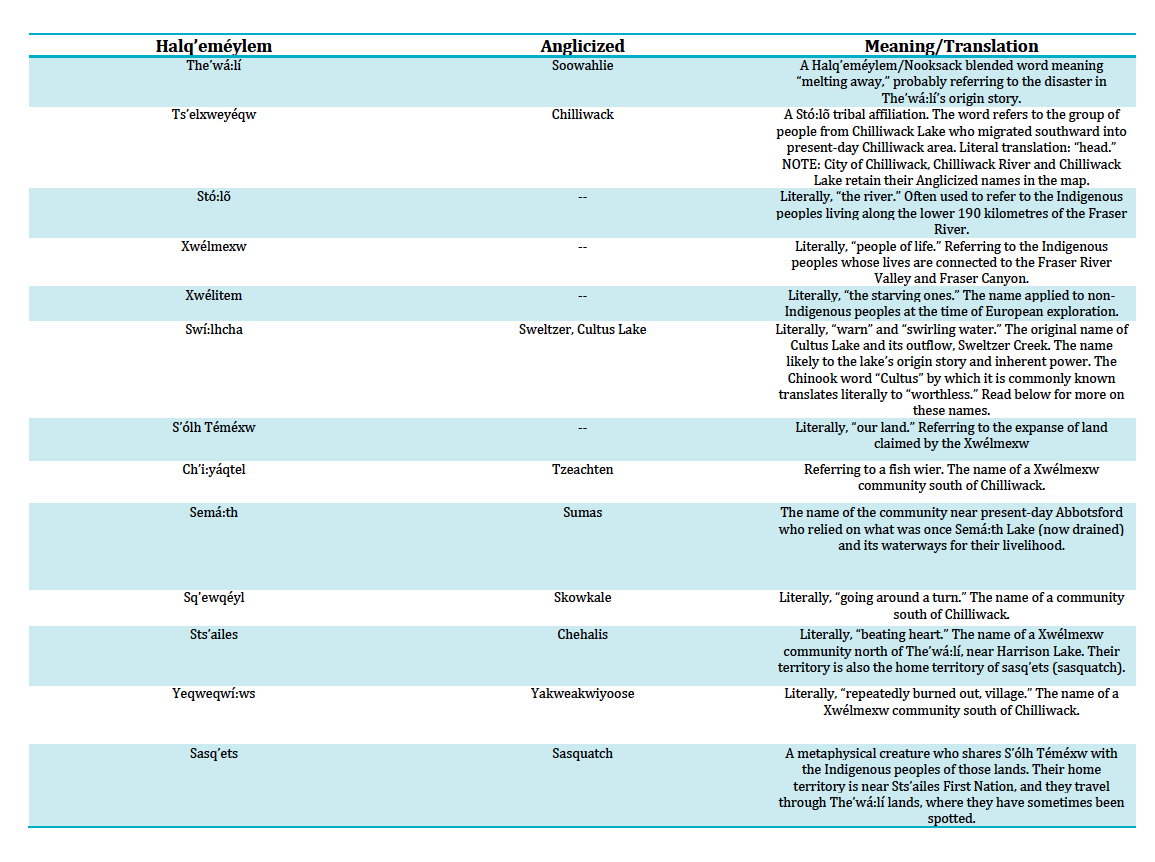
The’wá:lí’s territory is full of places with more than one name. This is because many places of importance have Halq’eméylem, English and Chinook names.
Placenames, according to some scholars, do not just indicate the location of a place. Rather, they are always associated with stories (1). Placenames give descriptions of important landmarks, and they also detail why a community values the place being named.
The original,
Halq’eméylem names of places in The’wá:lí territory, for example, have their own stories that
are important to understanding the value of the land for Xwélmexw people. As knowledge-holder Naxaxalhts'i (Sonny McHalsie)
writes, the naming of places within S’ólh Téméxw began thousands of years ago and continues
today
(2). Halq’eméylem names point to sxwõxwiyám stories about how the world was made, and sqwélqwel stories that explain the
origins of communities, families and the experiences of individuals. Some of these names
point to histories of change and disaster, such as floods, famines and migrations that were
central parts of Ts'elxweyéqw and larger Xwélmexw history.
The influx and increase in settler populations over the last two centuries, however, has resulted in some of these names being forgotten, others transformed with new, Anglicized spellings and meanings, and many replaced altogether with new names on maps and in the wider public discourse.
As a result, the process or phenomenon of naming and renaming…has been altered from an Indigenous course by the forces of colonialism
(3). The multiple names of places in The’wá:lí’s territory are important to think about, because many placenames represent Xwélmexw interpretations of and connections to the land, while other names are symbols of a history of colonialism and cross-cultural interactions.
The Halq’eméylem word The’wá:lí translates to melting away,
which is a direct reference to the catastrophe (in some stories a famine, in others a mudslide, and in others a flood) on which the community’s origin story is based. Thus, the placename itself, the name of the community, is a reminder of The'wá:lí’s origins, of their connections to Nooksack peoples across the border, and of their longstanding connection to traditional places such as Swí:lhcha (Cultus Lake).
The common, Anglicized name for the community, Soowahlie, only came into use when non-Indigenous explorers and settlers in the area found they could not pronounce the Halq’eméylem name, The'wá:lí. In addition, non-Indigenous government officials over the last two centuries have written this in many different ways (at least a couple dozen) in their records. Some examples of phonetic mispronouncing and different spellings include: So-why-lie, So-why-lee, Swoohalie, Soo-wah-lil, Tsowahllie, Too-y-lie, To-ylee and of course Soowahlie. The community has also been referred to as the “Cultus Lake Indians” in other documents.
These many different names for the community are symbolic of processes of colonialism and cross-cultural interactions in The’wá:lí territory over the last two centuries. They reflect the difficulties of translation across linguistic and cultural borders. They also shed light on larger processes of dispossessing Indigenous peoples of their places for non-Indigenous settlement and use.
An important part of of The’wá:lí’s identity is their Ts'elxweyéqw background. The word Chilliwack, given to the the city north of Soowahlie Reserve as well as the river that runs east-west through it and the lake on the east side of the Chilliwack River Valley, is the Anglicized form of this Halq’eméylem word. This word has also been spelled chihl-kway-uhk or chill-kway-uhk in some documents.
Another place with multiple names is Swí:lhcha, commonly known as Cultus Lake. The original, Halq’eméylem name refers to the disaster story explaining the origins of both the lake and the The’wá:lí community. It may also refer to the portals at the bottom of the lake. According to linguists Brent Galloway and Allan Richardson, the word Swí:lhcha, when taken apart, has two parts: it’s main root, wiy-, means warn,
and its suffix, -elhcha, means dirty water
(4). This might either refer to a warning that Swílcha is a dangerous place with stl'áleqem and tunnels that might kill incautious swimmers. It might also refer to the attempts of the young man from the basin village to warn his fellow villagers before the lake flooded.
Either way, the name Swí:lhcha points to Xwélmexw interpretations of this place. It indicates that the lake has always been considered powerful and potentially dangerous. It also refers to the community’s history and longstanding connection to the lake.
Indigenous peoples called the lake cultus,
meaning bad or worthless in Chinook jargon, to European explorers in the nineteenth century. While Amy Cooper said in 1963 that Xwélmexw people used the name cultus to explain to outsiders that the lake had been drained of its spirit power and therefore was now worthless,
other community members also argue that the name set it apart as a dangerous, taboo or xa:xa place.
Amy Cooper also says that the white man couldn’t say Swílcha
they thought that ‘Cultus’ was an Indian word, and called it Cultus Lake.
The same goes for the lake's primary out-flow, Sweltzer Creek. Amy Cooper's explanation points to cross-cultural and cross-linguistic translations (and mistranslation) and interactions.
Whatever the reason for the now-common use of the name Cultus, it stuck, both on maps and in public consciousness. Some colonial documents suggest that the use of this name indicated that the community no longer cared about or wanted the lake. This interpretation of the name cultus
thus was used to support non-Indigenous settlement in The’wá:lí’s territory around the lake. According to this interpretation, the Indigenous peoples considered the lake worthless
certain settler documents suggested, then non-Indigenous people could claim it as their own justifiably.
On the contrary, however, the lake never lost its value for the The’wá:lí community. The’wá:lí continues to identify with Swí:lhcha, and many people still refer to the lake by its Halq’eméylem placename. The popular use of the Chinook, rather than the Halq’eméylem, name, is indicative of a history of colonialism in which the people of The’wá:lí were in many cases displaced and disconnected from their places. At the same time, continued use of Halq’eméylem placenames indicates the persistence of the community’s longstanding, storied connections to their environment.
Writing History into the Landscape: Space, Myth and Ritual in Contemporary Amazonia.American Ethnologist 25, no. 2 (May 1998): 128-148.
Atlas Plate 45A, Halq’eméylem Place Names,in the Stó:lō-Coast Salish Historical Atlas, Keith Carlson, ed. (Seattle: University of Washington Press, 2001), 134-135.